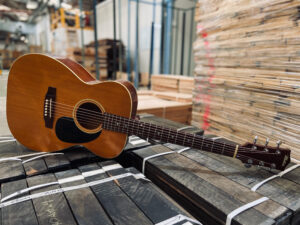








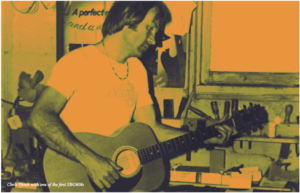
The story behind Maton’s iconic EBG808 series begins with Chris Ffinch. Chris had been employed at Maton since 1966 (two days after arriving in Australia from England) and by 1978 was well established as one of the finest guitar makers at Maton. Chris was known as a luthier in his own right and had a reputation as one of the best repairers in Melbourne.
He was also active in the Melbourne folk music scene at the time and was great friends with many of Melbourne’s best-known musicians. Sometime in 1978 Gordon McIntyre, one of the Australian folk scene’s best guitar players had a car accident in which his beloved Martin 00-18 was badly damaged.
Of course Gordon sought out Chris Ffinch to see if it could be repaired. Around the same time Chris had noticed that many of the folk singers at Frank Traynor’s Folk and Jazz Club (Melbourne’s premier folk music venue at the time) were playing smaller bodied guitars, mostly Martins, and was keen to add something like that to the Maton stable. Having Gordon’s smashed up 00-18 on the bench gave him the perfect opportunity to take some dimensions and design a Maton version of the small bodied guitar.
 What made the BG808 unique (and still does) was the combination of the small body, full body depth, and 25.5-inch scale length. Most other small bodied guitars have a scale length of 24.9 inches or occasionally 25.4 inches. All 808s also had a 100mm diameter sound hole rather than the 95mm sound hole usually found on smaller bodied guitars. We changed the spec to 95mm in 2014 as part of the redesign of the range at that time. The BG808 was made from the same materials as the CW80 at the time (as was the Jumbo CJ85). It seems we were creating a
range based on the success of the CW80 which had transformed significantly since its launch in 1967, but that’s another story…. So, as with the CW80, the 808 had a Sitka Spruce top, Qld Maple two ply sides (with the interior ply being basswood) and a three-ply basswood back. The neck was Qld Maple with an Indian rosewood headstock veneer. The guitar also featured an Indian rosewood bridge and fingerboard with 6mm Mother of Pearl position dots. The was painted with a satin finish over a honey-stained top with walnut stained back, sides and neck. The binding was ivory coloured ABS. It was a beautiful little guitar with a lovely, bright top end and a very lively mid-range response.
What made the BG808 unique (and still does) was the combination of the small body, full body depth, and 25.5-inch scale length. Most other small bodied guitars have a scale length of 24.9 inches or occasionally 25.4 inches. All 808s also had a 100mm diameter sound hole rather than the 95mm sound hole usually found on smaller bodied guitars. We changed the spec to 95mm in 2014 as part of the redesign of the range at that time. The BG808 was made from the same materials as the CW80 at the time (as was the Jumbo CJ85). It seems we were creating a
range based on the success of the CW80 which had transformed significantly since its launch in 1967, but that’s another story…. So, as with the CW80, the 808 had a Sitka Spruce top, Qld Maple two ply sides (with the interior ply being basswood) and a three-ply basswood back. The neck was Qld Maple with an Indian rosewood headstock veneer. The guitar also featured an Indian rosewood bridge and fingerboard with 6mm Mother of Pearl position dots. The was painted with a satin finish over a honey-stained top with walnut stained back, sides and neck. The binding was ivory coloured ABS. It was a beautiful little guitar with a lovely, bright top end and a very lively mid-range response.
They sold quite well for the time (133 over 1978 – 79) and the 78 version found their way into the hands of several notable performers. John Williamson being perhaps the best known at the time. I remember hearing one in the hands of Kavisha Mazzella in the early 90s, (before I knew what it really was) and I’ve seen a few pop up at folk clubs and open mic nights since. Every now and again we have one come into the repair shop for some restoration work or to have a pickup system fitted. What’s in the BG808 name? The name of this guitar always puzzled me. ‘BG’ stands for Bluegrass. As a long time folk musician myself I am very familiar with the bluegrass tradition, and as far as I was aware, the iconic standard bluegrass guitar was a loud mahogany back and sides dreadnought.This little guitar is far from that, and I believe was developed for fingerstyle players rather than ‘banjo-killing flatpickers’.
Chris thought it may have been titled after ‘Blues Guitar’ which makes more sense. Perhaps it started that way and became ‘Bluegrass’ somehow. As for the ‘808’. The answer to this question is probably lost in time, although it may be that the 80 refers to the 80 of the CW80. Perhaps the final 8 a comment on the pronounced figure 8 of the body shape. Perhaps it just sounded good… According to Chris, Bill May would always come up with model names and numbers... B.G.808 Serial No:31 (10/78)
I vividly recall stringing it up as it hadn’t been played for many years, adjusting the neck and playing a few chords. It was very disappointing. I showed it to Derek Chan, our repairer at the time, with the comment of ‘oh well, it was worth a try’. Derek played it and said, ‘are you sure? There’s something going on here’. I played it again and the old guitar started coming to life. Gradually it found its voice. It sounded different to our more recent 808s. The mid-range was especially punchy and the bass light, but very present. This is not the first time I’ve had a guitar ‘wake up’ when playing it. It’s quite common with brand new guitars as they learn to vibrate and start loosening up. Every now and again it happens with repairs and older guitars as well. So here it is. A 1978 original condition Maton BG808. Oh, except for the machine heads